10
Birds are the fastest and most powerful fliers in the
animal kingdom. A bird’s wing is light, strong, and
flexible. It is also convex in shape, curving slightly from
front to back, which helps to pull the bird upwards as it
flaps through the air. Although the
size and shape of wings vary,
they all share the same
basic design.
Alula
This group of feathers from an owl
covers the front edge of the
wing. The alula provides
lift to the wing during
unsteady manoeuvres
such as landing.
The
wing
Flapping
failures
Early inventors did not
realize that flapping
flight would always be
beyond the power of
human muscles.
Within
the limit
A bird’s wings
can bear its
weight, plus
anything it is carrying,
such as food or
nesting materials.
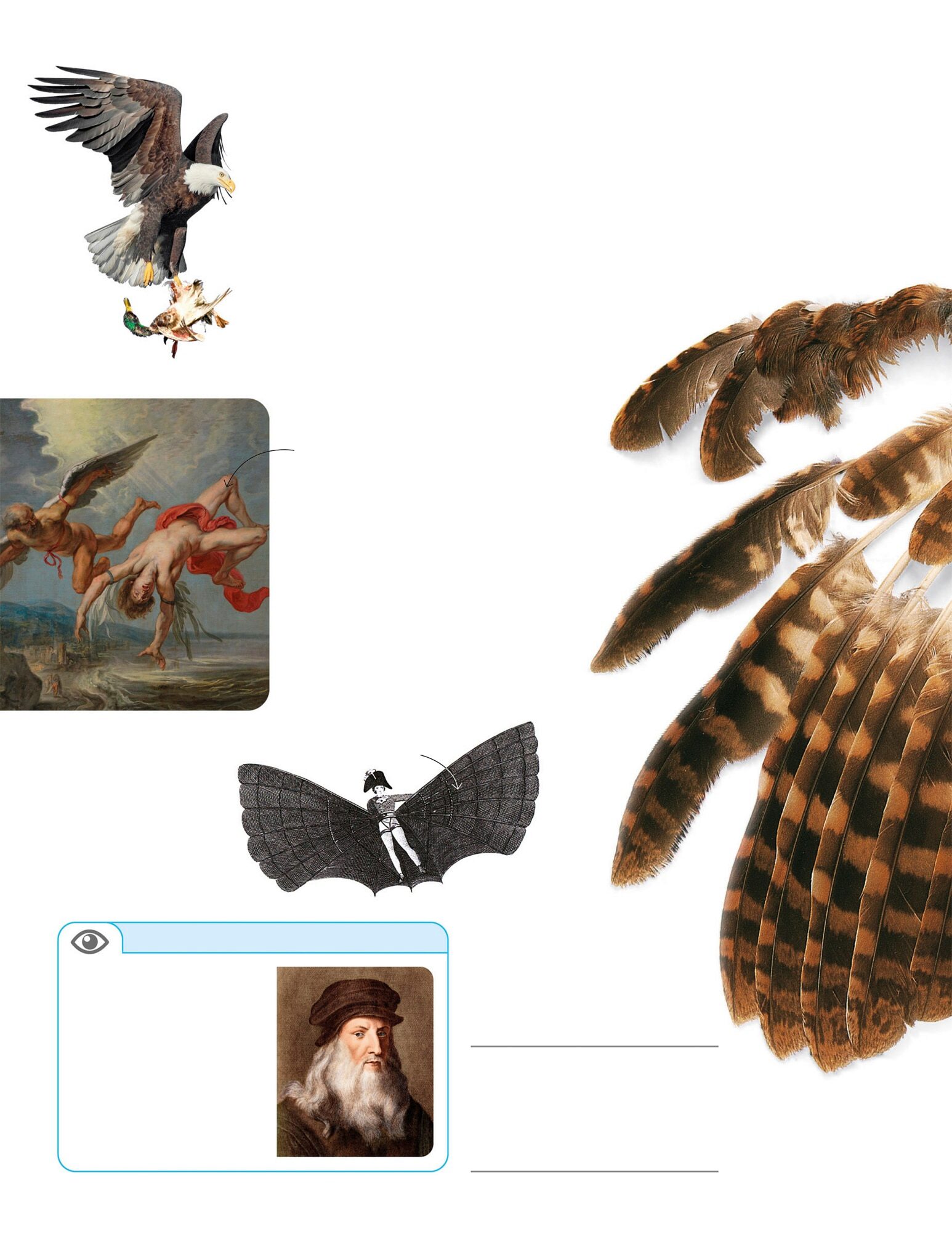
Leonardo da Vinci
Italian artist Leonardo da Vinci
(1452–1519) was also a brilliant
engineer. He was fascinated
by how birds fly. He studied
their wing structures and
observed their flight. These
observations inspired him to
design many flying machines,
but none of them took off.
EYEWITNESS
Icarus falling
to the ground
The Flying
Philosopher
etching
Too high
In Greek legend, Icarus
flew too near to the Sun,
causing the wax that held
his feathers to melt. But
birds flying at high altitude
have to cope with quite
different and much more
real problems – scarce
oxygen and intense cold.
A bird’s
plumage
weighs more
than its
skeleton
.
Primary flight
feathers
The “primaries” produce the
power for flight. The outermost
primary feathers can be used
for steering.
Bald eagle carrying
a mallard